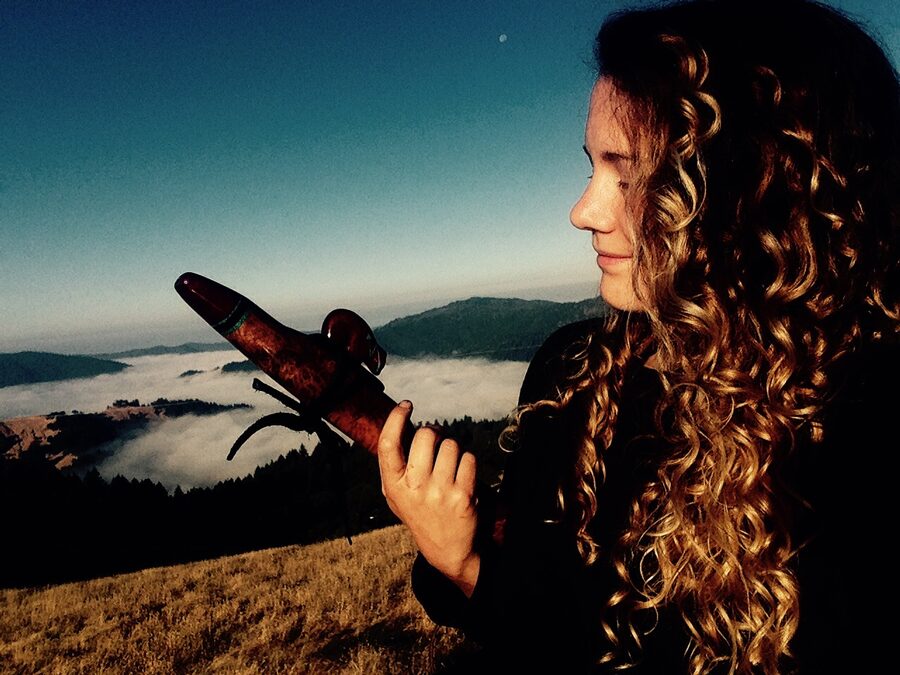
Native American Flutist · Published 28 July 2026 · ~4,500 words · 15 min read
Everything I would tell a new student in one place — anatomy, history, sound, how to choose one, and how to learn to play.
This is the guide I wish I'd had when I started. It is the closest thing I can give you to a single, complete overview of the Native American flute — what it is, where it came from, why it sounds the way it does, how to choose your first one, and what it takes to learn to play it well. After thirteen years on this instrument, twenty-eight countries traveled with it, and several thousand hours teaching it to beginners, this is what I would say if you sat down across from me and asked me to tell you everything.
Each section below is a summary. Many sections link out to longer essays — the rest of the journal here is the deeper version of each topic. Use this guide as a map. Follow the links wherever you want to go further.
The Native American flute is a wooden, end-blown flute with two air chambers separated by a small block. You hold it vertically in front of you, blow gently into the mouthpiece end, and a song appears almost effortlessly. By reputation and by reality, it is one of the easiest instruments in the world to start playing — and one of the deepest to keep playing.
Unlike a Western concert flute (held sideways) or a recorder (single chamber), the Native American flute has two chambers linked by a carved channel. The first chamber collects your breath. The air then travels through a narrow gap under a removable wooden block — often carved as a bird or animal, called the "totem" or "bird" — and strikes a sharp edge that splits the air and produces the sound. The second chamber, with finger holes, is where you shape the melody.
Most Native American flutes are tuned to a minor pentatonic scale — five notes that sit together harmonically and never produce dissonance. There are no "wrong notes" available to play. This makes the instrument extraordinarily accessible to beginners and deeply expressive for experienced players.
For a fuller exploration of the instrument's anatomy and basic playing principles, see my essay on what a Native American flute is.
The flute, as a category of instrument, is among the oldest musical objects we have evidence for. The Hohle Fels flute, recovered from a cave in southwestern Germany, dates to roughly forty-two to forty-three thousand years ago — carved from the radius bone of a griffon vulture, with five finger holes. The Geissenklösterle flutes, also in Germany, may be even older. By the time human beings were painting on the walls of Tassili n'Ajjer in what is now Algeria, the flute had already been in human hands for tens of thousands of years. The instrument I'm writing about here is one branch of a very old tree.
The Native American flute, in something like its current two-chambered form, has been played for several hundred years across many Indigenous nations of what is now the United States and Canada — including the Lakota, Anishinaabe, Apache, Navajo, Pueblo, and others. Different nations developed different traditions: in some, the flute was associated with courtship; in others, with healing; in others, with quiet personal reflection.
In the late twentieth century the instrument experienced a public revival, led in large part by Indigenous artists including R. Carlos Nakai (Navajo/Ute), Mary Youngblood (Seminole/Aleut), Robert Mirabal (Pueblo), and Kevin Locke (Lakota/Anishinabe). Their recordings, performances, and Grammy-winning albums brought the Native American flute to listeners worldwide.
For more on the cross-continental history of the flute as a category, see From Tassili to North America. For specific listening recommendations from the contemporary revival, see the listening list of famous Native American flute players.
The defining musical feature of the Native American flute is its tuning: the minor pentatonic scale. A Western piano has twelve notes per octave. A standard major or minor scale uses seven of those twelve. A pentatonic scale uses five.
In the key of A minor, the pentatonic notes are A, C, D, E, G. In G minor: G, B♭, C, D, F. The mathematical feature that matters: there are no semitones (half-steps) between the notes of the pentatonic scale. Without semitones, there is no source of dissonance. Every combination of pentatonic notes sounds harmonious. The beginner who covers and uncovers finger holes at random discovers, immediately, that the instrument produces pleasing music.
This is the single most important fact about playing the Native American flute. The instrument removes the "I am producing bad sounds while I learn" phase that most other instruments require. You sound musical from day one. Not polished — that takes years — but musical.
The tone itself is what most listeners describe as "warm," "breathy," "contemplative." The sustained quality of the breath, the resonance of cedar (or walnut, cherry, or redwood), and the natural reverberation of the bore all combine into a voice that suits atmospheric music, meditation, ceremony, and reflective settings more than it suits jazz solos or pop melodies.
For the music theory behind the pentatonic scale, see The Pentatonic Scale and Why It Sounds Right. To hear what the flute actually sounds like across different moods, listen through three of my recordings on this post.
The single most important decision in choosing a first flute is not the wood, not the price, and not even the key — it is the maker. A flute from a reputable maker, even at the lower end of their price range, will be in tune with itself across all its notes, responsive to gentle breath, and durable. A flute from an unknown or factory source will often be out of tune with itself, regardless of how beautiful it looks. The first will pull you toward practice. The second will sit on a shelf and quietly convince you that you "don't have the talent for it." That is the actual decision.
For a first flute, the practical defaults that work for nearly everyone:
For the longer version, see Choosing Your First Native American Flute. For the deeper "best for what?" framework on choosing between specific options once you know what you want, see Is There a "Best" Native American Flute?. For the wood-specific deep dive, see What Wood Should Your First Flute Be?.
A handmade Native American flute represents dozens of hours of work from a single craftsperson. The process roughly: select dry cedar (or other wood); cut and shape the body; drill two long parallel chambers along the length, using specialized gun-drill setups for straightness; carve the fipple (the breath-shaping channel and edge) by hand and ear, testing airflow until the flute speaks cleanly; carve the block (the "bird" or "totem") that sits on top of the fipple; drill the finger holes and tune each one individually against an electronic tuner, often spending an hour or more on tuning alone; sand the body progressively through finer grits; apply flute-safe bore oil to the inside chambers and natural hardwax oils to the outside.
The most skill-intensive steps are the fipple carving and the tuning. Both are pure handcraft — no machine fully replaces them. A flute can look beautiful and still be out of tune with itself if either step is rushed. This is the entire reason why a flute from a respected maker is worth several times the price of an Amazon look-alike: you are paying for the maker's accumulated decisions in those handcraft steps, condensed into the instrument now in your hands.
For the full walkthrough of the making process, see How a Native American Flute Is Made.
Within the Native American flute family there are several specialized variations worth knowing about.
The drone flute (sometimes called a "double flute") has two parallel chambers in a single body. One chamber, the drone side, has no finger holes and plays a fixed fundamental note. The other chamber, the melody side, has the standard finger holes tuned to the minor pentatonic. The player blows into both blow-holes at once. The result is a built-in two-part harmony from a single instrument — like a bagpipe carved from cedar. Drone flutes are best for fuller, sustained, ambient music; they require more breath than a single-chamber flute and are usually not a first instrument.
Bass flutes are longer instruments in lower keys (E, F, or lower) with deeper, more cavernous voices. They require more breath, larger hand spans, and produce music that fills larger spaces.
Multi-key sets — many performers carry several flutes in different keys, choosing which to play depending on the room, the audience, and the mood. A starter player needs one flute. A working performer often carries three to six.
For more on drone flutes specifically, see The Drone Flute: A Deeper Voice in the Native American Family.
The Native American flute is one branch of a global flute family that stretches back tens of thousands of years and across nearly every human culture. The bansuri (India), shakuhachi (Japan), dizi (China), ney (Middle East), and bamboo suling (Indonesia) are all close cousins — each shaped by different peoples, in different places, into the voice each tradition needed. The breath that plays them is the same. The scales, embouchures, and cultural histories differ.
I personally play the Native American flute as my primary instrument, with the bamboo suling as a frequent companion (you can hear it on my recording Ambient Suling). I have spent time with the others — bansuri, shakuhachi, dizi, ney — without performing on them. Each one would take years of dedicated practice to play seriously, and each one belongs to a specific cultural tradition that deserves respect from outsiders learning it.
For an introduction to those other world flutes and how they relate to the Native American flute, see World Flutes Beyond the Native American Tradition. For a meditation on what carrying a Native American flute across twenty-eight countries has taught me, see Why the Native American Flute Travels Well.
Before you start playing, listen. The body of recorded Native American flute music is rich, varied, and reasonably accessible. A short list of the most important figures, all of whom belong on any serious listening journey:
For the longer listening list with brief portraits of each player and recommended albums, see Famous Native American Flute Players: A Listening List for Beginners.
Most students play a recognizable song within their first hour with the instrument in hand. This is the reward of the pentatonic scale: the instrument cooperates from day one. The hard work isn't producing notes — it's producing music that feels intentional. That's a longer practice, and it's what lessons are for.
A typical first year of practice covers:
You can learn without lessons. Many students do, drawing on YouTube tutorials, books like Clint Goss's The Native American Flute, and the resources at Flutopedia. Lessons accelerate the process and help you avoid the small habits that become hard-to-fix later. I teach online via Zoom to students worldwide, and in person where I am physically based — currently Sydney, soon North Carolina.
To learn from me directly, see the lessons page.
This is the section that matters most and is the easiest to handle poorly. The Native American flute belongs to a real cultural lineage rooted in real Indigenous nations. The instrument's modern public revival was driven by Indigenous artists and continues to be led by Indigenous voices. Anyone who picks up this instrument, regardless of heritage, plays it in conversation with that lineage.
For Indigenous players: this instrument is yours by inheritance. The lineage is in the blood and in the practice.
For non-Indigenous players: the instrument is open to learn, but it is not yours by inheritance. The right posture is gratitude — to the makers, players, and traditions that kept the instrument alive long enough for everyone to learn it. Honor the Indigenous artists by listening to them, by attributing what you play, by not claiming traditions you weren't given. The instrument welcomes you. The cultures that built it deserve respect.
For me — a Native American flutist of Tejana heritage, with family lineage tracing to the Indigenous peoples of Nuevo León in the Texas/Mexico borderlands — the question of cultural context is a daily one. I play the Native American flute as someone Native American by lineage, holding an instrument whose voice was kept alive by other Indigenous nations whose specific traditions I do not claim. There is no contradiction in this for me. There is, instead, a quiet thanks to the makers and players who carried the music far enough for the rest of us to find it.
For the spiritual context across multiple Indigenous traditions — Cherokee, Lakota, Navajo, Coahuiltecan — see Songs for the Crossing. For the cross-continental view of how the flute connects far older musical histories, see From Tassili to North America.
If you've made it this far, you probably want to do something. Here are the three paths most readers take from here:
And if you're considering hiring a Native American flutist for a wedding, memorial, retreat, or private event: my performance offerings cover six different formats from intimate gatherings through extended retreat residencies, with worldwide availability.
The Native American flute is one of the oldest instruments anyone is still actively playing. It has carried meaning in human hands for longer than recorded history. Whatever drew you here — curiosity, grief, beauty, longing, instruction — the instrument is patient enough to meet you wherever you are. The rest is breath.