Native American Flutist · Published 31 May 2026
An introduction to the instrument — its anatomy, its scale, its history, and why it's one of the most accessible flutes in the world to start playing.
The Native American flute is a wooden, end-blown flute with two air chambers separated by a small block. You hold it like a recorder, blow gently into one end, and a song appears almost without trying. It is, by reputation and by reality, one of the easiest instruments in the world to start playing — and one of the deepest to keep playing.
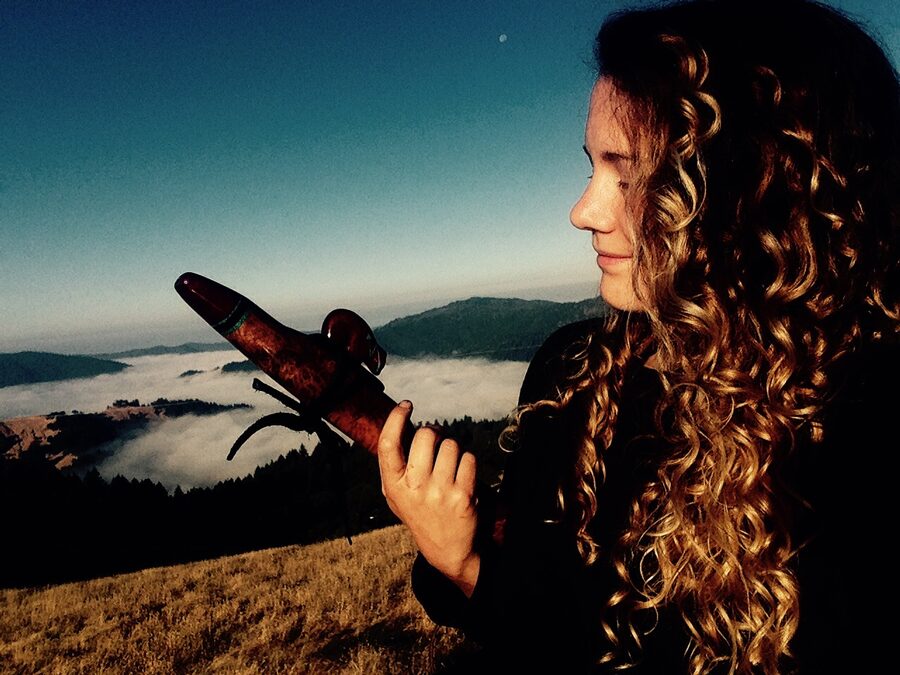
Unlike a Western concert flute (which you blow across like a bottle), or a recorder (which has a single internal chamber), the Native American flute has two chambers linked by a carved channel. The first chamber, nearest the mouthpiece, collects your breath. From there, the air travels through a narrow gap under a removable wooden block — often shaped like a bird, an animal, or a simple geometric form — and strikes a sharp edge that splits the air and produces the sound. The second chamber, with finger holes, is where you shape the melody.
The block, sometimes called a "totem" or "bird," is what gives the instrument its name. It can be removed and re-tied with a leather thong, which lets the player fine-tune the airstream by shifting the block forward or back by a millimetre or two.
Most Native American flutes are tuned to a pentatonic minor scale — five notes that sit together harmonically without ever sounding wrong. Cover any combination of finger holes, blow gently, and you will produce a note that fits with every other note. There is no equivalent of a "wrong key" the way there is on a piano. This is the single most important fact about the instrument: it makes playing music feel possible to people who have never been musical, and it lets experienced players improvise freely without having to "think" their way through the music.
The Native American flute, in something like its current form, has been played for several hundred years across many Indigenous nations of what is now the United States and Canada — the Lakota, Anishinaabe, Apache, Navajo, Pueblo, and others. Different nations have different traditions and different styles of song. In some traditions, the flute was associated with courtship; in others, with healing; in others, with quiet reflection.
In the late twentieth century the instrument experienced a public revival, led in large part by Indigenous artists like R. Carlos Nakai (Navajo/Ute), Mary Youngblood (Seminole/Aleut), and Robert Mirabal (Pueblo). Their recordings, performances, and Grammy-winning albums brought the Native American flute to listeners worldwide. The instrument that you can buy and learn to play today is the result of that revival — at once a continuation of older traditions and a contemporary instrument made and played by a wide community of musicians.
Native American flute music shows up most often in spaces where atmosphere matters more than performance: meditation and yoga playlists, spa and wellness settings, wedding ceremonies, memorial services, retreat openings, and film scores set in the American Southwest. If you've ever heard a single sustained wooden tone holding up a quiet scene, there's a good chance it was this instrument.
Most people are surprised by how quickly they can play a recognizable song — often within the first hour with an instrument in hand. The hard part isn't making notes; it's making the music feel intentional. That's where lessons help most. If you'd like to hear what the instrument can do, the Music page has performances and recordings, and the listening list of famous Native American flute players covers the artists who shaped what this instrument has become. If you're ready to think about owning one, the first-flute buying guide is the next step.