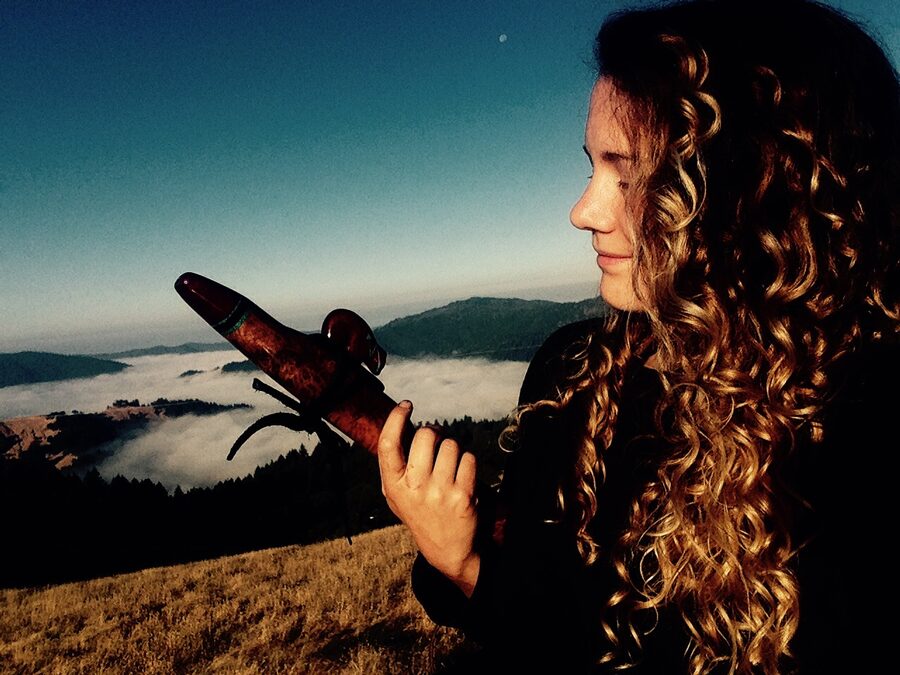
Native American Flutist · Published 12 June 2026
The honest answer is: better than I can describe it. So here — listen.
Writing about how an instrument sounds is like writing about the taste of water. You can say "warm" and "breathy" and "contemplative," and none of those words actually puts the sound in your ear. So this post is going to be short on prose and long on listening. Three of my own recordings, across three different moods, with brief notes on what you're hearing and why.
Press play and let it sit underneath whatever you're doing.
That's a single Native American flute, no overdubbing, no accompaniment. The qualities you're hearing: sustained tone (the way a note can hold steady for a long breath), warm cedar resonance (the woody quality underneath the pitch), and the slight breath texture that comes from the player's air across the fipple. These are the qualities the instrument is known for. Quiet, intimate, breath-driven, more about atmosphere than melody-as-statement.
This one uses a bamboo suling — a related world flute from Indonesia, not a Native American flute, but cut from similar musical cloth: end-blown, pentatonic-leaning, breath-driven. I include it here because part of how I work is letting the world flutes speak to each other across traditions. If you're considering the Native American flute family broadly, this is the kind of sonic territory it can travel into — more ambient, more layered, less obviously "folk" in flavor.
A medley named for an ancient North African landscape. More melodic movement, more ornamentation, more interplay between phrases. You can hear me using the instrument as a storyteller here — phrases that build, breathe, resolve, build again. This is closer to what I'd play at a live performance: still atmospheric, but with more shape. The connection between the Native American flute and other ancient flute traditions is something I write about in my essay on how the flute bridges continents.
Three things, mostly.
The closest reference points, if you're trying to place the sound: the shakuhachi (Japanese bamboo flute — also intimate and breath-driven, harder to play), the quena (Andean reed flute — similar tone, different scale), the bansuri (Indian bamboo flute — transverse, more chromatic). The Native American flute is in this family. If you've enjoyed any of those, you'll find a home in this one.
For more of my own recordings across more moods, the full music page has the rest. And if you'd like to hear what the masters of the instrument sound like, the listening list of famous Native American flute players is a longer education than I can give in one post.