Native American Flutist · Published 14 July 2026
Notes from a flutist who's carried the instrument across twenty-eight countries — and what playing in Bali taught me about playing anywhere.
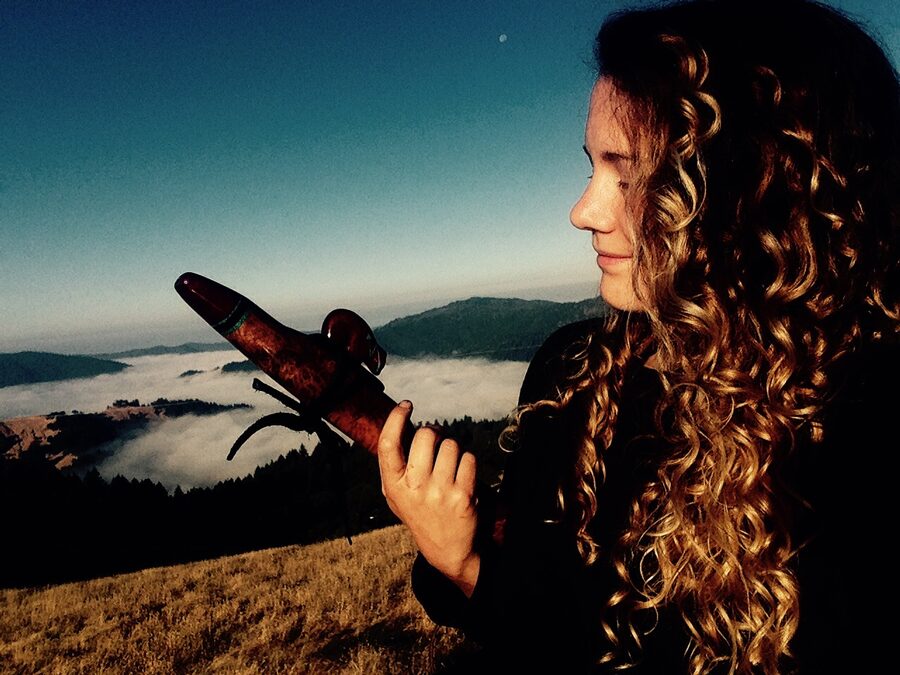
I have played the Native American flute in twenty-eight countries. Some of those moments were performances. Many were quiet hours alone, sitting on a hotel balcony in a city I had just arrived in, letting the same instrument I had played at home find what to say in a new place. This essay is about what I have learned from carrying this instrument across the world — and why it is, in my honest opinion, one of the best traveling instruments in existence.
A standard Native American flute is between roughly twenty-four and thirty-six inches long. It fits in a soft case in a carry-on. It does not require electricity. It does not need to be tuned to anything else, ever — its tuning is built into the bore. There are no fragile strings, no reeds to replace, no electronics to fail in humid airports. Cedar flutes are more delicate than PVC or resin flutes, but with reasonable care — keeping the flute out of direct sun and out of bags wedged hard against luggage — they survive years of travel without complaint.
The acoustic profile is forgiving. The instrument carries clearly outdoors without amplification, and it does not overwhelm an indoor space. You can play it in a rented room without disturbing the neighbours. You can play it on a beach without competing with the surf. You can play it on a mountain trail without scaring wildlife. Few instruments are this universally welcome in this many environments.
One of the things that surprised me first about playing in many countries was how much the place itself shapes the sound. The same flute, in the same key, played by the same player, sounds different in different rooms — and different rooms have nothing to do with national borders. A flute in a Balinese rice terrace at dusk sounds nothing like the same flute in a sandstone canyon in the American Southwest. A flute in a hotel courtyard in Sydney sounds nothing like the same flute in a Buddhist temple in Kyoto. The wood and the breath are unchanged; the reverberation, the humidity, the ambient sound, and the player's own attentiveness all shift, and the music shifts with them.
This taught me something I would not have learned by playing only in one place: the place is part of the instrument. The same notes mean different things in different rooms. A long sustained tone in a stone-walled canyon becomes hymnal. The same long tone over rice paddies becomes pastoral. The same long tone in a Tokyo apartment becomes intimate and contained. Each environment makes you play differently, because each environment hears differently.
Bali is where I learned the most about playing the Native American flute, paradoxically, because Bali has its own flute. The bamboo suling is Indonesian, end-blown, breath-driven, and tuned to scales that overlap meaningfully with the pentatonic. Standing in a region where the local instrument is a sibling of the one I had brought from across the world made me rethink what I was carrying.
The suling and the Native American flute are different — different woods, different scales, different cultural histories. But the breath that plays them is the same. The way the player's air becomes pitch is the same. The way both instruments calm a listener's body is the same. I have come to believe this is the universal feature of flutes everywhere: the bridge from breath to music is one of the simplest, most universal acts of human creativity. There is a longer version of this argument in my essay on the flute as a bridge across continents.
Playing in Bali — sometimes alongside suling players, sometimes alone — taught me to play the Native American flute with more openness to other influences. I still play traditional Native American flute songs faithfully when the occasion asks for it. But when I am improvising, my breath carries Bali, and Sydney, and the American Southwest, and Tassili, and every other place I have played. You can hear some of that on my music page.
I think every long-distance traveling musician learns the same lesson eventually: the music you make does not belong to the place you started. The Native American flute I play came from a tradition rooted in the American Plains and Woodlands. The bamboo suling I sometimes play came from Indonesia. Neither of them is from where my body now sits, and yet, the breath that plays them is. Music has always been a thing carried across borders. The Native American flute, more than most instruments, is built to be carried.
For more on which flute to start with if you are interested in the same kind of journey, see the first-flute buying guide. And if you would like to learn what it actually feels like to play, lessons are open online from anywhere in the world.