Native American Flutist · Published 4 June 2026
The flute as a bridge across continents — notes on a new recording, and on the long thread connecting an Algerian plateau to the instrument I play.
The newest track on my SoundCloud is called Tassili n'Azjer Native Flute Medley. Tassili n'Ajjer is a place I have never been — a Saharan plateau in southeastern Algeria, near the borders of Libya, Niger, and Mali, where some of the oldest documented art on Earth has been preserved on stone walls for more than twelve thousand years. The medley is named for it. The reasons take a little explaining.
Tassili n'Ajjer became a UNESCO World Heritage Site in 1982 and contains more than fifteen thousand rock paintings and engravings catalogued by archaeologists since the early twentieth century. The art records a stretch of human history beginning around the eighth millennium BCE — when the region that is now sand was a green savanna with rivers, lakes, hippopotamus, and giraffe. Cattle herders moved across it. Hunters tracked game across grasslands. People danced, gathered, painted what they lived. Then the climate shifted, the Sahara slowly dried, and the people moved on. The paintings remained.
When you look at images of Tassili rock art today — and most of us only ever look at images, because the actual site is remote and difficult to reach — you see human figures in mid-motion. Some are stylized, round-headed and abstract; others are precisely realistic. You see herds. You see what archaeologists describe as scenes of dance and gathering. Whether they played flutes specifically, the paintings don't tell us. What they tell us is that people were making, moving, and being together with intention long before any of us were here to remember it.
We can say one thing with confidence: by the time humans were painting on the walls of Tassili, the flute had already existed in human hands for at least thirty thousand years. The oldest physical instrument ever found is a flute — the Hohle Fels flute, recovered from a cave in southwestern Germany in 2008, carved from the radius bone of a griffon vulture, with five finger holes, dated to roughly forty-two to forty-three thousand years ago. The Geissenklösterle cave, also in Germany, has produced flutes that may be older still. The makers were anatomically modern humans living during the Aurignacian period of the Upper Paleolithic.
What this means, with as little drama as possible: the flute is one of the oldest known instruments in the world. It does not belong to any single nation, any single continent, any single tradition. It belongs to humans, plural — across continents and across deep time. By the time the people of the green Sahara were painting on stone, the flute had been in someone's hands for tens of thousands of years already.
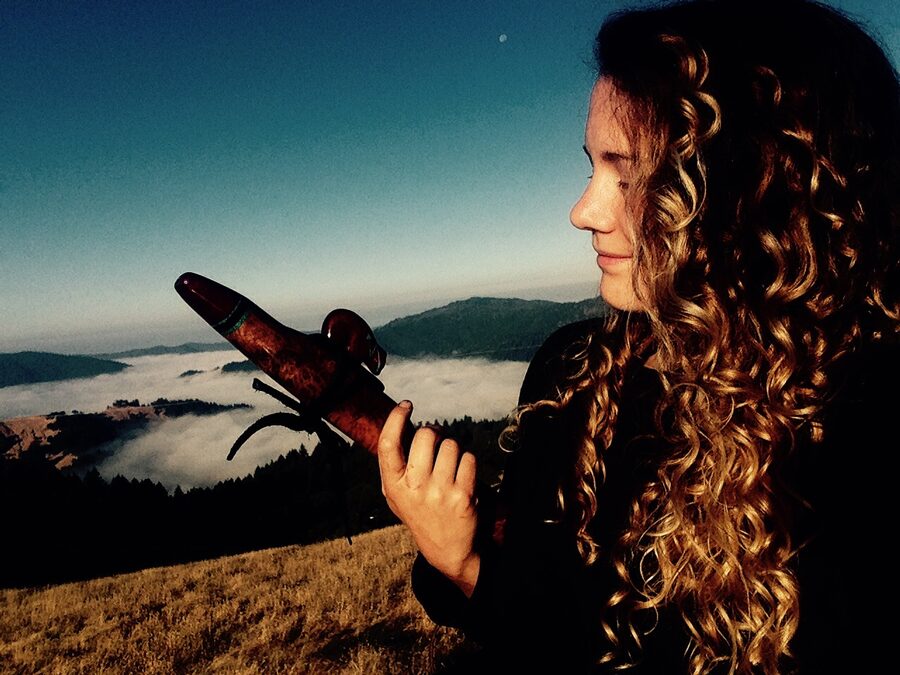
The Native American flute I play — two-chambered, cedar, tuned to a pentatonic scale — is one branch of an enormous tree. The bansuri of India. The dizi of China. The shakuhachi of Japan. The ney of the Middle East. The bamboo suling of Indonesia. The gourd, clay, and reed flutes of African and Arabian traditions, including the ones whose voices once moved through the air over the rivers that no longer run across the Sahara. All of these are branches of the same ancient instrument, refined by different peoples in different places, over thousands of years, into the voice each tradition needed.
I am drawn to this thread because it is honest. There is no single owner of the flute. There are only the players, the makers, and the listeners across millennia who have agreed, in their own languages and through their own breath, that this particular shape of air through wood or bone or clay says something we cannot quite say otherwise.
When I recorded the Tassili n'Azjer Native Flute Medley, I was thinking about a place I have never seen and music whose specific notes I will never hear. I was holding an instrument whose lineage stretches back further than nearly anything we make. I was, in a small and personal way, trying to honor the thread.
My own lineage runs through Tejana heritage and the Indigenous peoples of Nuevo León, in a borderlands tradition whose specific musical practices were disrupted by colonization and survive now in fragments. The Native American flute is not historically the instrument of those nations — it belongs to other Indigenous traditions across North America, which kept it alive long enough for the rest of us to learn it. I play it with gratitude, and I play world flutes alongside it because I genuinely believe the music of one place can speak honestly to the music of another, when held with respect.
That is why I record medleys named for places I have never been. Not because I am claiming those places — I am not. Because the breath is shared. Because the act of playing is older than any of us, and longer than any borders. Because somewhere in the silence between two notes on a cedar flute in Sydney, there is something a cattle herder in the green Sahara might have recognized.
The Tassili paintings will eventually weather away. The Sahara is hostile to fragile pigment. UNESCO and Algerian authorities are doing what can be done to preserve what can be preserved, and high-resolution photography and scanning are archiving what stone alone cannot hold forever. But the music — the impulse that made people gather and dance and breathe through hollow bone forty thousand years ago — has not weathered. It is in every flute that anyone is still willing to play.
The medley is on the music page if you would like to hear it. Listen with that long thread in mind.