Native American Flutist · Former Funeral Director · Published 31 May 2026
The flute, the spirit's journey, and what many Indigenous traditions hold about the music that walks beside the dead.
Across mountain villages and reservation cemeteries, in chapels and at gravesides under wide open sky, there are songs that have been carried for a long time toward the moment when one person crosses from this world into whatever comes next. Some are vocal. Some are drum. Some are prayer with no melody at all. And in many traditions across the Americas, somewhere in that sound there is also a flute.
What we believe music does in those moments depends on the tradition we come from. But across many Indigenous nations and many centuries, a quiet thread runs through: music is not only for the living to express grief. It is also, in some tellings, for the spirit itself — to keep them company, to mark the way, to keep them from getting lost.
Among the Cherokee, mourning was carried in part by crying songs — sorrowful chants performed to assist the soul of the deceased and to give the living somewhere to put their grief. The songs are documented in the historical record, including in the body of work catalogued at Flutopedia, but have always been understood as more than performance. They were the work of moving someone along.
The Lakota speak of the spirit's path differently. In their teachings, the soul travels along Wanáǧi Tȟačháŋku — the Spirit Path — what many of us know as the Milky Way. At the far end is Mayá Owíčhapaha, the old woman who judges each soul. The Lakota Nagi Gluhapi, the Keeping of the Soul, is a year-long rite in which the soul of the deceased is wrapped in sacred buckskin and kept by a designated Keeper, who vows to live in harmony with all relations until the soul is released. Songs and prayers carry the soul along that whole year. The full tradition is preserved by Lakota cultural institutions including St. Joseph's Indian School, and described in cultural studies of Lakota bereavement.
The Navajo hold a four-day mourning ceremony, in which specific songs and prayers guide the spirit so that it does not linger between worlds. Great care is taken — even at the gravesite, footprints are deliberately covered so that the spirit-guide does not mistakenly follow the wrong person home. The practices are widely documented in funerary scholarship and in Navajo cultural sources.
Across these traditions there is no single map of the afterlife. There is no single song. But there is a shared knowing: that music walks beside the dead, and that someone has to be willing to play.
The Coahuiltecan peoples — hundreds of autonomous bands of hunter-gatherers whose territory once stretched across eastern Coahuila, northern Tamaulipas, western Nuevo León, and southern Texas — held their own traditions around music and ceremony. The archaeological record shows what survived: percussion above all. Gourd rattles, specifically Nuevo León gourd rattles perforated with small holes and filled with the gravel-like detritus from ant mounds. Rasps. Drums. Music to hold a dance, to encourage the trance state of ritual, to mark the seasons of life and the seasons of grief.
The arrival of the Spanish in the sixteenth century, followed by disease, mission resettlement, and the slow violence of forced assimilation, disrupted nearly all of it. What remained survived in fragments — in family memory, in songs whose original meaning was no longer fully remembered, in the practice of descendants who carried the music forward without always knowing exactly where it came from.
This is the lineage I descend from. I was raised in South Texas, and my family's roots trace to those bands and those territories. What I carry of that heritage is partly in the blood, partly in the practice — and partly in the willingness to play music for the dying and the dead even in a tradition where so much specific knowledge was taken.
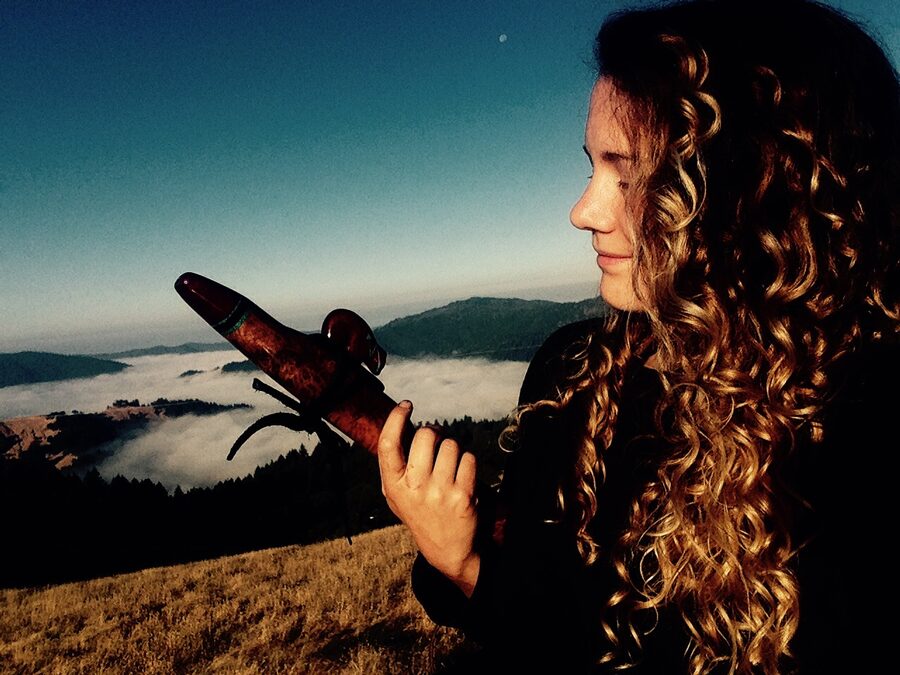
The Native American flute I play is not, historically, a Coahuiltecan instrument. The two-chambered cedar flute belongs to other Native American traditions — Plains, Woodland, and beyond. I play it as a flutist who is Native American by lineage, holding an instrument whose voice was kept alive by other Indigenous nations. There is no contradiction in this for me. There is, instead, a quiet thanks to the makers and players who kept the music going long enough for the rest of us to learn it.
The Native American flute has older and broader uses than the funerary one. In Plains tradition it was a courting instrument, played outside a beloved's lodge in the evening. In other traditions it accompanied healing, prayer, and the quiet hours of personal meditation. It has been described, again and again, as an instrument that helps in communicating with the spirit world.
What makes it sit well in a room of grief, specifically, is something musicians and morticians both know: the flute does not compete. It is breath made visible. It can sustain a single note long enough to hold a silence and then let the silence return. A song on the Native American flute does not demand a room's attention. It allows it.
Before I became a flutist full-time I spent six years as a licensed funeral director and mortician in the United States. I sat with families on the worst days of their lives. I watched what music did in those rooms — what worked, what didn't, what people actually wanted near them when there were no more words.
I learned that the families who asked for a song were almost never asking for performance. They were asking for something to walk beside the moment. Sometimes the song was a hymn. Sometimes a fiddle tune. Sometimes a request from the person who had died, written down years before. Whatever it was, it did the same work: it kept the room from being empty when grief asked for more than silence could hold.
When I play the flute at a memorial now, I am thinking about that. About the long traditions across many nations that have understood music as something more than sound. About my own ancestors and what they may have played in similar moments, in a language we have mostly lost. About the family in front of me, who needs someone to keep playing while they cry.
There is no single teaching shared by all Indigenous nations about the road the spirit walks. There are, instead, many traditions, many songs, and many people across many centuries who have agreed on one quiet thing: that the moment of crossing should not happen in silence.
Whoever you bury, whoever you grieve — there are old reasons for the music. The flute is one of them.