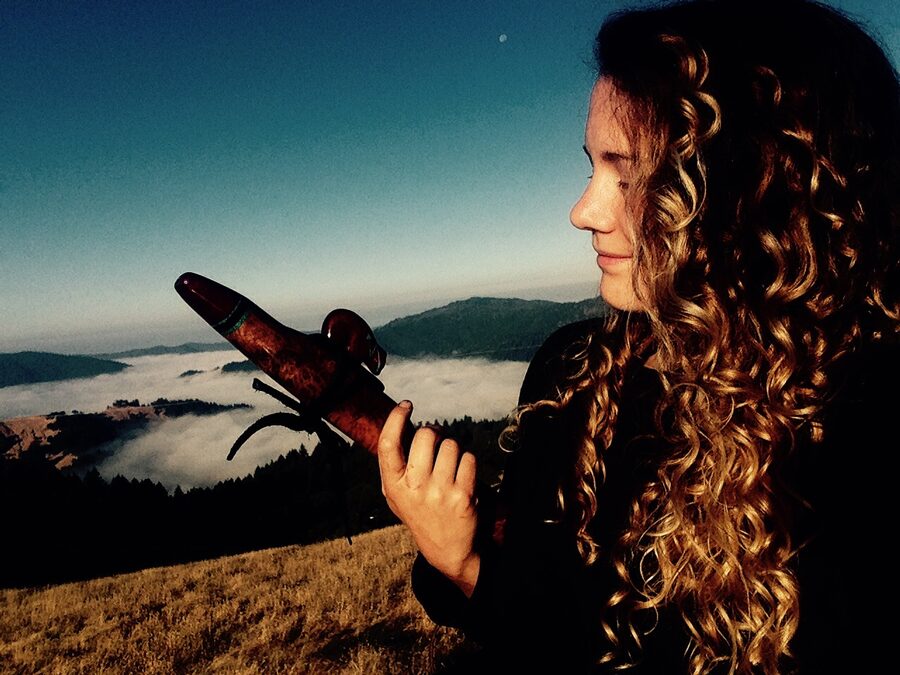
Native American Flutist · Published 21 July 2026
A flutist's introduction to the bansuri, shakuhachi, dizi, ney, and suling — and the family they share with the instrument I play most.
The Native American flute is what I play most often, but it is not the only flute I play. Over thirteen years and twenty-eight countries of travel, I have gathered a small collection of world flutes — instruments from other traditions that I love for their voices and that, more often than not, I have ended up using alongside the Native American flute in my own recordings. This is an introduction to the major members of the world flute family for anyone curious about where else the breath can go.
The bansuri is a transverse (side-blown) bamboo flute, central to Indian classical music for thousands of years. In Hindu mythology, it is the instrument of Lord Krishna; in classical practice, it is one of the most demanding and most rewarded melodic instruments in the tradition. The bansuri player slides between notes in a way that Western instruments largely cannot — microtonal bends, fast ornaments, melodies that flow into each other without breaks. The signature sound: meditative, emotional, deeply continuous.
The bansuri overlaps with the Native American flute in materials (bamboo / wood) and in spirit (both atmospheric, breath-driven). It differs in technique — the transverse embouchure is much harder to learn — and in scale, since the bansuri can play chromatic notes the pentatonic Native American flute cannot. For a Native American flute player curious about world flutes, the bansuri is a beautiful but ambitious next step.
The shakuhachi is an end-blown bamboo flute carved from the root end of the bamboo stalk, with origins traced to the 8th century. It became deeply associated with Komusō Zen Buddhist monks, who played it as a form of meditation. The sound can shift from a near-silent breath to a piercing tone with the smallest movement of the lips, and the playing technique called muraiki — a breathy, airy attack — produces what listeners often describe as the sound of wind through bamboo.
Shakuhachi practice is famously difficult. The embouchure (the way the lips shape the air across the end of the bamboo) takes years to develop. It is the closest world flute to the Native American flute in intent (meditative, contemplative, breath-driven) and the furthest in execution. The two instruments are spiritual cousins more than playing cousins.
The dizi is a transverse bamboo flute with archaeological cousins dating back roughly 9,000 years — making it among the oldest playable instruments ever found. The signature feature is a small additional hole covered by a thin paper or membrane (the dimo), which adds a bright, buzzing quality to every note. The result is a sound that cuts cleanly through ensembles, which is why the dizi is central to Chinese folk music and opera.
The dizi is technically very different from the Native American flute — transverse, membrane-augmented, chromatic — but it sits in the same broad family of breath instruments shaped by long traditions of human use.
The ney is a hollow reed flute with roots stretching back to ancient Persia, Egypt, and the broader Middle East. It appears on Egyptian tomb paintings between 3000 and 2500 BCE, making it one of the oldest still-played instruments in human history. Its sound is breathy, soulful, and famously associated with the poetry of Rumi and the spiritual practice of Sufi devotional music.
The ney has a notoriously difficult embouchure — players blow across the rim of the open end of the reed at a specific angle, and beginners often produce nothing but air for weeks before achieving a clear note. Once mastered, it is one of the most emotionally direct flutes in any tradition. The breathy quality and the long sustained tones make it closer to the Native American flute in mood than most other instruments, even if the playing technique is wildly different.
The bamboo suling is the flute of Indonesia — particularly Bali and Java — and the world flute I personally play most often besides the Native American flute. It is end-blown like a recorder, made from a single piece of bamboo, and pitched to scales that overlap meaningfully with the minor pentatonic that the Native American flute is built on. The suling is intimate, atmospheric, easier to start playing than the bansuri or shakuhachi, and visually beautiful.
You can hear a suling on my recording Ambient Suling on the music page. The instrument is also worth knowing about for its travel story: the suling family spread from Southeast Asia to Madagascar in outrigger canoes with the island's first settlers — one of the long oceanic journeys of music we have evidence for.
I do not play the bansuri, the shakuhachi, the dizi, or the ney at performance level. I play the suling, occasionally a drone flute (which lives in the Native American flute family), and a few other simple bamboo instruments. The instruments I do not perform on, I have still spent time with — handling them, playing them quietly, listening to recordings, asking what they can do that my main instrument cannot.
What this does, over years, is teach you what is universal about flutes and what is specific. The universals — breath, sustained tone, the act of bringing pitch out of empty air — they belong to every flutist who has ever lived, regardless of tradition. The specifics — the scales, the embouchures, the cultural histories — they belong to particular peoples and practices, and they should be honored as such. I write about this more in my essay on how the flute bridges continents and millennia.
For listening: I have built playlists across many of these traditions over the years. For a beginner introduction, the listening list for Native American flute is the right starting point. From there, search for R. Carlos Nakai's collaboration with William Eaton (cross-cultural), Hariprasad Chaurasia (bansuri), Watazumi Doso (shakuhachi), and any recording of Kudsi Erguner (ney). Each one will open a door.