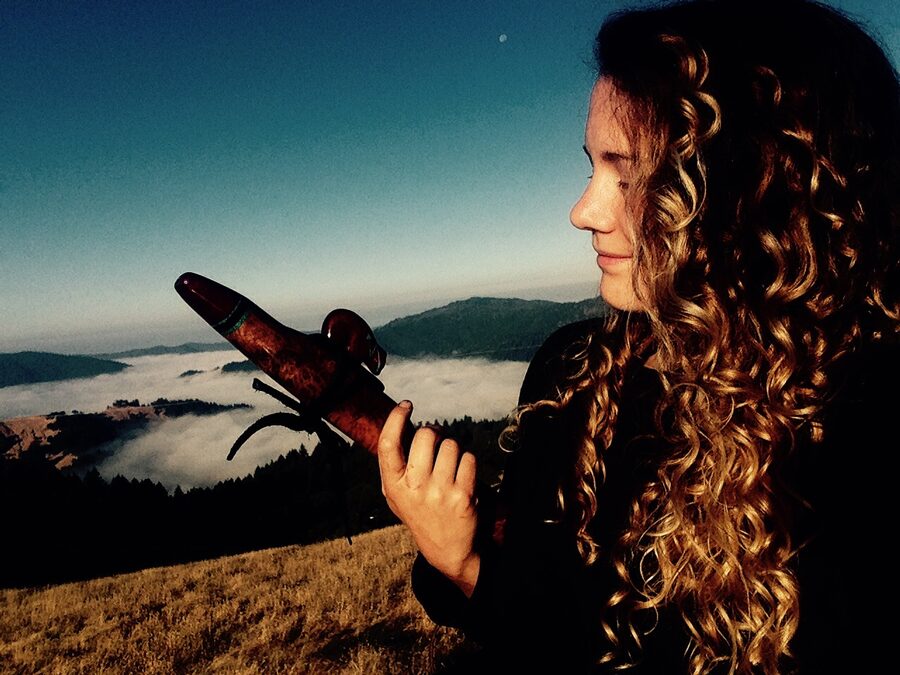
Native American Flutist · Published 9 June 2026
A single instrument with two chambers — a fundamental drone underneath, a pentatonic melody on top. Like a bagpipe carved from cedar.
A standard Native American flute has two chambers: one to collect your breath, one to shape your note. A drone flute has three. The third chamber is a second flute, built into the same body, with no finger holes — it plays one sustained note for as long as you blow into it. While that note holds, the melody side does its work above. You play both at once, with the same breath, and what you hear is a single instrument that sounds like two.
Drone flutes are typically a single one-piece body with two parallel chambers side by side. Both chambers share a single mouthpiece block on top, and the player blows into both blow-holes simultaneously. The drone chamber has no finger holes — it produces a fixed fundamental note tuned to the key of the flute. The melody chamber has the standard five or six finger holes tuned to the minor pentatonic scale, matching the same key as the drone.
Because the two chambers are tuned in harmony, every note you play on the melody side resonates against the held drone. It's the same physics that makes a bagpipe work, or a tanpura in Indian classical music: a constant pedal tone underneath, melody floating above. The result is a built-in two-part harmony from a single player.
A single-chamber Native American flute is intimate. It carries breath and silence and one melodic voice. It works beautifully for solo meditation, for ceremony, for a quiet room.
A drone flute is fuller. The constant low tone underneath gives the music a kind of architectural floor — a held bass note that makes the room feel anchored. SunCrow describes the effect as bagpipe-like, and they're not wrong — there's a sustained density to a drone flute that you don't get from a single chamber. It's a sound that fills larger spaces, holds longer silences, and supports vocals or other instruments naturally because the drone provides the harmonic foundation.
A drone flute is more physically demanding. You're feeding air to two chambers at once, so it requires roughly twice the breath of a single flute. Long phrases need real breath control, and beginners often run out of air faster than they expect. The fingering on the melody side is identical to a standard Native American flute — if you can play one, you can play the other — but your lungs will let you know which is which.
Most drone flutes are also physically larger than a single-chamber flute in the same key, because the body has to hold two parallel bores. That makes them heavier in the hands and less ideal for travel. They live on your stand at home, ready when you want that fuller voice.
I keep drone flutes in my collection because there are rooms a single-chamber flute can't fill, and there are moments that ask for the fuller voice. Most of my live performances use single-chamber flutes — they're more nimble, lighter, more responsive. But when a piece wants weight, the drone is what I reach for. You can hear some of that texture in my recordings on the music page.
A drone flute is not usually a first flute. The breath requirement is real, and starting on a single chamber gives you a foundation in tone and fingering that makes the drone much easier to learn later. If you're new to the Native American flute, my buying guide for first flutes covers what to start with. After a year or two of comfortable playing, a drone in the same key as your first flute is a natural next step — the same fingerings, the same scale, a fuller voice. Reputable drone-flute makers include Singing Tree, Stellar, and the maker most of my own flutes come from, Woodsounds.
One flute is enough to last a lifetime of playing. Two is not better, exactly — it's different. A drone flute is an instrument you grow into, when the music you want to make starts asking for more room.