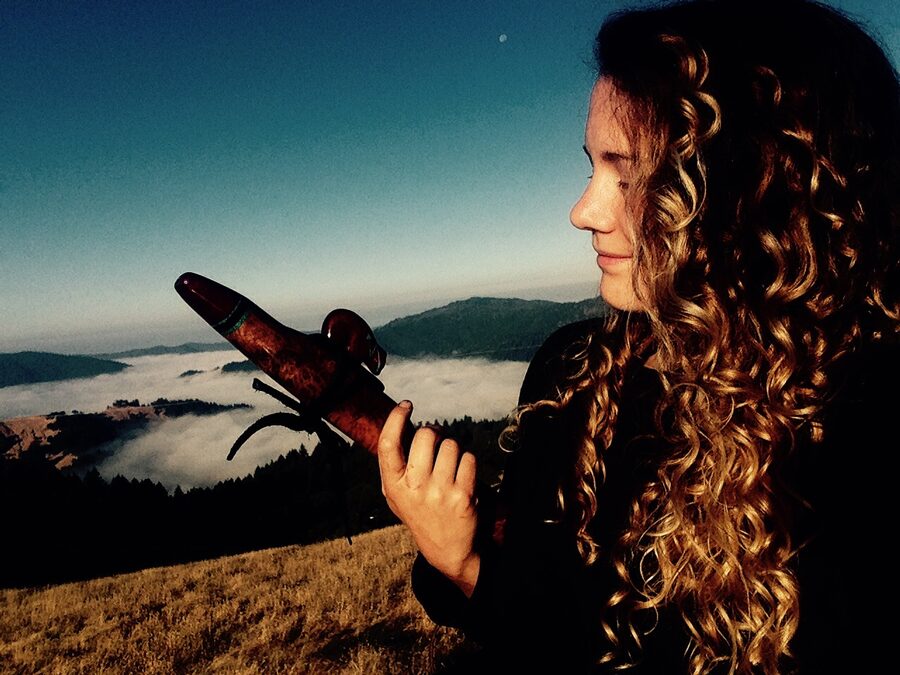
Native American Flutist · Published 15 September 2026
The pentatonic scale makes improvisation possible from your first day on the instrument. Practical exercises for players who hear the word "improvise" and freeze.
The word "improvise" intimidates many players unnecessarily. We picture a jazz musician at midnight, fingers blurring over keys, inventing genius melodies on the spot. That's one kind of improvisation. There are many other kinds, and the kind you can do on a Native American flute from your first hour on the instrument is much closer to quiet wandering than to virtuoso invention. This post is for anyone who wants to start improvising and doesn't know where to begin.
The minor pentatonic scale the Native American flute is tuned to contains no dissonance. Every combination of fingerings produces notes that sit together harmonically. There is no chord progression to follow. There is no "wrong" note to avoid. You are free, mathematically, to play any note in any order at any speed. This is the opposite of how most instruments work, and it changes everything about what improvisation feels like.
Improvisation on the Native American flute is less about creating melody and more about letting melody happen. Your job is not to decide where the music is going. Your job is to follow what your breath suggests and trust that what you produce will fit.
Sit somewhere quiet. Hold the flute. Cover all the finger holes. Take a deep, slow breath. Blow gently, producing the lowest note of the flute — the fundamental — and hold it for as long as your breath comfortably lasts.
That's exercise one. Do this for five minutes. No melody yet. Just one note, sustained, with attention to the breath underneath it. This is improvisation's foundation. You cannot improvise musical phrases without first being able to support a sustained tone.
Now: same setup. Take a slow breath. Play the lowest note for one full breath. Lift the bottom finger off. Play that new note for one full breath. Cover the bottom finger again. Repeat.
You are now improvising. It does not feel like improvisation because you're only moving between two notes, but you've already made every artistic decision improvisation requires: when to change notes, when to breathe, how long to hold. The number of notes is not what makes something improvisation. The decision-making is.
Add notes gradually. Three, then four, then five. Don't think about melody. Think about breath. Each phrase is one exhalation long. When you run out of breath, the phrase ends. You inhale. Then the next phrase begins.
Practice letting the breath decide the phrase length, the dynamics (loud at the start of the exhale, soft at the end), and the natural pause between phrases. The instrument follows the body. The body, allowed to do its work, makes music.
Sit by a window. Or outside, if you can. Listen for a full minute before playing anything. Hear what the room sounds like — the wind, the small house sounds, the distant traffic, the silence. Then play a single phrase that responds to what you just heard. Not depicting it — responding to it. If the room felt still, your phrase might be still. If you heard a bird, your phrase might rise.
This exercise teaches you the most important skill in flute improvisation: playing toward something rather than from nothing. Improvisation that comes from nowhere tends to feel arbitrary. Improvisation that responds to an environment, a feeling, a memory, or a piece of silence has direction.
Pick a recording from the listening list of famous Native American flute players — R. Carlos Nakai's Canyon Trilogy works well. Or pick one of mine on the music page. Play along quietly. Don't try to copy notes exactly. Try to match the mood — the speed of the phrases, the length of the silences between them, the rise and fall of the dynamics.
This is how players in many oral traditions actually learn improvisation: by imitating recorded or live music until the patterns become part of how their breath wants to move. You will not be playing what the recording plays, but your phrases will start to feel shaped by the same energy.
Improvisation on the Native American flute is, at its core, an act of following. Following the breath. Following the moment. Following the silence between notes as carefully as the notes themselves. Players who try to lead the music — who try to compose impressively as they go — usually sound forced. Players who follow what the breath and the room suggest usually sound natural. The instrument is on your side. Let it do part of the work.
The longer arc of becoming an improviser is years long. The arc of starting is one breath long. Everything written above can be done in a single sitting, today, with whatever flute you have. There is no required preparation. There is only the willingness to begin without knowing exactly what you're going to do.
For the music theory behind why this instrument makes improvisation possible, see The Pentatonic Scale and Why It Sounds Right. For the broader conversation about how players learn this instrument, see Learning by Ear vs Reading Music. For the complete picture, see The Complete Guide to the Native American Flute.
And if you'd like personal guidance on developing your improvisation — past the exercises in this post — lessons are open online worldwide via Zoom, or in person.