Native American Flutist · Published 29 September 2026
Native American Heritage Month is five weeks away. A reflection on what it is, where it came from, and how descendants of Indigenous nations can honor it.
November is Native American Heritage Month in the United States. It will be here in five weeks. This post is a quiet preparation — a look at what the month is, where the designation came from, what it means for descendants of Indigenous nations, and what I'm planning to share in the November posts to come. It is not a list of things to do for Heritage Month. It is a place to start thinking about what the month is for, before the month begins.
Native American Heritage Month — also called American Indian and Alaska Native Heritage Month — is observed throughout November. It was officially designated by Presidential Proclamation in 1990, when President George H.W. Bush signed a joint resolution from Congress establishing it. Earlier designations existed in various forms: an "American Indian Day" advocated by Red Fox James, a Blackfeet member, in 1915. A 1976 "Native American Awareness Week" under President Ford. The 1990 designation was the formalization of decades of effort by Indigenous advocates to have the contributions of Indigenous peoples publicly recognized.
The month is observed across federal agencies, schools, museums, and many cultural organizations. The Library of Congress, National Archives, National Park Service, Smithsonian, and others maintain dedicated programming and resources. nativeamericanheritagemonth.gov is the official portal.
Federal designations of heritage months can sometimes feel performative — a way of signaling recognition without committing to ongoing change. The honest history is more complicated. The Indigenous advocates who pushed for this recognition over decades did so because for most of the United States's existence, Indigenous peoples were systematically erased from public memory, public education, and federal policy. The month exists not as a ceremonial gesture but as a structural intervention against ongoing invisibility. It is one tool among many.
It is also, importantly, not a finish line. The month is one designated space for amplification of Indigenous voices. It does not absolve any institution — or any individual — from the broader work of recognition during the other eleven months. Critics within Indigenous communities have long pointed out that the structure of "heritage months" can let mainstream institutions check a box once a year and forget the rest of the time. This is a fair critique.
For Indigenous people, the month is an opportunity for visibility, for reconnection, for sharing work, for amplifying community resources, for naming aloud what is so often pushed quietly to the margins.
For descendants of Indigenous nations who do not live within their ancestral communities — and I am one — the month is something a little different. It is, sometimes, a complicated reminder of disrupted lineage. My own ancestry traces to the Indigenous peoples of Nuevo León in the Texas and Mexico borderlands; the specific traditions of those nations were significantly disrupted by Spanish colonization, and the lineage I carry is, in many ways, fragmentary. Heritage Month for me is partly a season of attending to those fragments — the family stories, the names, the practices that survived, the practices that didn't.
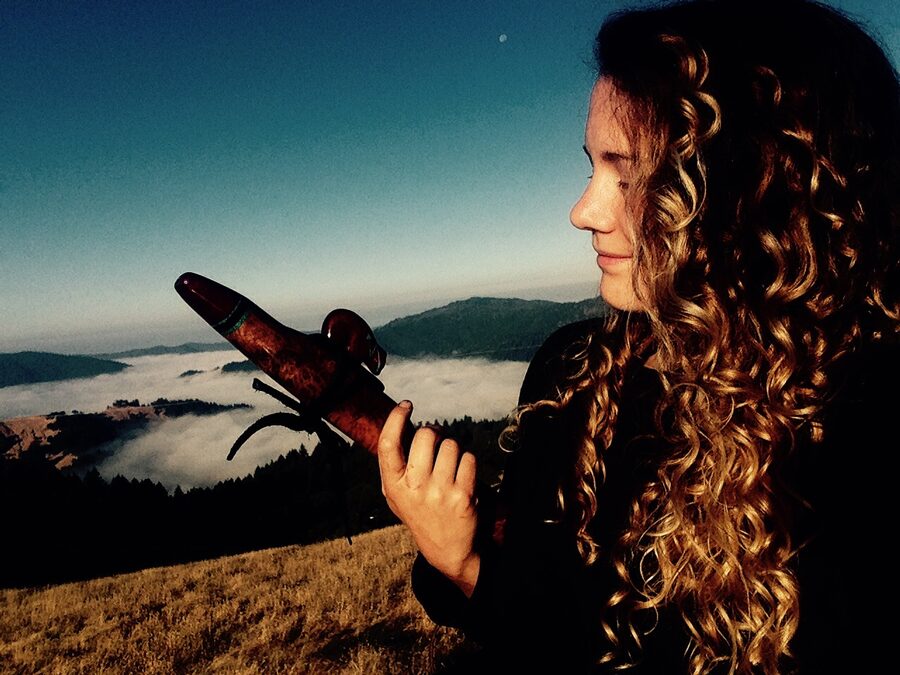
It is also a season of honoring the Indigenous traditions whose music I now play. The Native American flute I play belongs historically to Indigenous nations whose specific cultural inheritance I do not claim. Their work in keeping the instrument alive is what made it possible for me to learn it. Heritage Month, for me, is partly a season of saying that out loud.
If you are not Indigenous and you are wondering what to do with the month, a small set of suggestions:
The next post on this journal will be Native American Heritage Month and the Sound of the Flute, the seasonal piece for the month, going live in mid-October. Through November, the journal will lean more heavily on cultural and spiritual context posts: deeper dives into the Indigenous traditions of the borderlands my family comes from, the place of music in Native American mourning practices (a continuation of Songs for the Crossing), and an extended listening guide for Heritage Month specifically.
Five weeks from now, the month begins. Now is when I start preparing for it. The instrument has been a teacher of attention for me. Heritage Month is, among other things, attention asked of all of us. I'd like to make sure I'm ready to give it.
For the broader picture of the instrument I play and the lineage that carries it, see The Complete Guide to the Native American Flute. For the heritage piece my own work draws on most directly, see Songs for the Crossing.