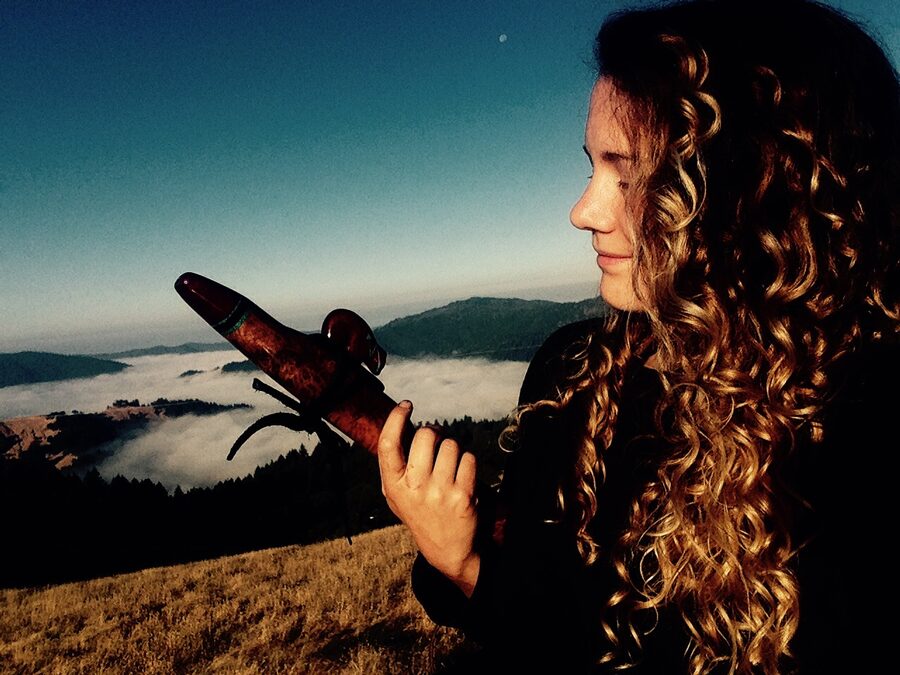
Native American Flutist · Published 14 October 2026 · Seasonal pinned post
November is Native American Heritage Month. A reflection on what the month is for, what music can carry that words sometimes cannot, and the flute's quiet role in keeping a long thread alive.
November in the United States is Native American Heritage Month — a federal designation since 1990, building on advocacy that goes back to 1915. Every year, the month brings what every heritage month brings: an upswell of public attention, museum programming, school assemblies, hashtag campaigns, brand statements, and a quiet question from many of us who carry Indigenous lineage about what to do with it all. This post is a flutist's attempt to answer that question, or to begin to.
Native American Heritage Month was formally established by Presidential Proclamation in November 1990, signed by President George H.W. Bush, after Congress passed a joint resolution earlier that year. The designation grew out of decades of advocacy — including a 1915 proposal by Red Fox James, a Blackfeet member, for an "American Indian Day," and a 1976 "Native American Awareness Week" under President Ford. The 1990 designation made the recognition permanent and gave it a full month rather than a single day or week.
In practice, the month is observed across federal agencies (Library of Congress, National Archives, National Park Service, Smithsonian), schools and universities, museums, cultural organizations, libraries, and many private institutions. The official federal portal coordinates much of the public programming.
Indigenous critics of the month — and there are many — have long pointed out a real tension: heritage months can become performative without substance. Institutions that go silent on Indigenous concerns for eleven months of the year cannot make up for that silence with a single month of programming. The month is a tool. Whether it is used well depends on what is built into the other eleven months.
Native American Heritage Month asks something different from each of us depending on who we are and how we came to be where we are.
For Indigenous people — particularly those who are enrolled in nations, who live in their ancestral communities, who carry direct lineage through known cultural channels — the month is an opportunity to amplify work, to gather, to teach. The work is yours to define. This post is not addressed to you in any prescriptive way.
For Indigenous descendants whose lineage was disrupted by colonization — many of us, including me — the month is a more complicated season. My family roots trace to the Indigenous peoples of Nuevo León, in the borderlands where South Texas meets northeast Mexico. The specific traditions of those nations were significantly disrupted by Spanish colonization, mission resettlement, and the slow violence of forced assimilation. What I carry is fragmentary — pieces of family memory, ancestral place, body. Heritage Month, for me, is partly a season of acknowledging that fragmentation and tending to what survived. It is also a season of acknowledging that the Native American flute I play belongs primarily to other Indigenous traditions whose work I draw on with gratitude.
For non-Indigenous readers, the month asks something specific too. Not just to listen — though listen — but to do so in a way that opens into the other eleven months. Annual recognition that vanishes on November 30 is, in some ways, worse than no recognition at all, because it confirms that visibility was always available and was simply withheld for a calendar year. The month is an invitation to recalibrate what is normal.
Of all the things that Heritage Month can amplify, music has a particular role. Music carries what archives cannot. It survives translation badly, which is to say it survives translation in its own form. A song from one tradition cannot be fully captured in writing about that song; it can only be carried by the playing of it. The Native American flute, like many Indigenous instruments, is itself a kind of archive — a memory of breath, of attention, of a tradition's specific relationship to silence and sound.
In Songs for the Crossing I wrote about the role of music in Indigenous mourning traditions across multiple nations. The same principle holds in less heavy contexts: music walks beside the moment. It carries what the moment is.
During Heritage Month, music can do for institutions and individuals what it does in those mourning rooms. It can carry attention to a moment that words alone cannot reach. The Native American flute, the powwow drum, the contemporary work of Indigenous artists across genres — these are not background music for the month. They are part of what the month is for.
For my own practice this November: I plan to write more publicly than usual about the Indigenous traditions whose music I draw on. I plan to share specific recordings from Indigenous artists who deserve more attention. I plan to play music — for myself, in private; for clients, in performance — that reflects the attention the month is asking for. I plan to honor the lineage I carry by attending to it more deliberately than usual. I plan to be honest about what I know, what I don't, and what the month means for someone in my particular position.
The November posts coming on this journal will reflect that. Each Tuesday in November, a deeper-dive piece on a different Indigenous musical or cultural tradition. The posts will reflect both the broader Indigenous music conversation and my own particular relationship to the lineage I carry.
The simplest framework I can offer:
Heritage Month is not closure. It is not a finish line. It is one month a year when the work of paying attention to Indigenous lives, voices, art, and traditions is made publicly easier. The other eleven months are when that work is harder, less supported, less normal — and therefore more important.
The flute I play has been in human hands, in some form, for tens of thousands of years. The Native American flute specifically has carried meaning across centuries of disruption and revival. The instrument is a thread connecting us to people who have already lived, to people now living, to people who will be playing it long after I am gone. November is one month to give that thread the attention it always deserved.
For more, see my essay on Songs for the Crossing, the deep historical view in From Tassili to North America, and the broader picture of the instrument in The Complete Guide to the Native American Flute.
Heritage Month begins on the first of next month. There is no preparation required other than the willingness to start.